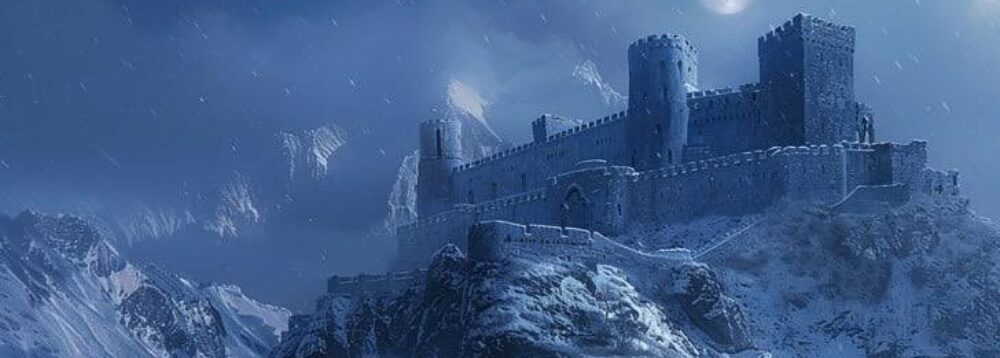
A day or two down the road to the Greyfax estate, as the Crimson Calling has just finished setting up camp and is starting their evening chores, a lone man approaches leading a horse.
The man is wearing a heavy winter cloak, and a simple undyed tabard. Under the cloak and tabard, the observant make out dark-red, almost black chain mail and the hilt of odd shaped, dark-handled sword. It reminds those that remember of the blade Ethelred called “Bushwacker,” but longer.
The man raises his arms confidently in the universal gesture of peace,
“Hail, I am Rask Felmar, of Thater that Was. You must be the Crimson Calling.” He calls out confidently.
Another Troll About To Be Born?
As the group is about to leave their two week spot after getting Dauntless, Alexis muses to his companions “I can only imagine Leer’s troll powder supply is getting pretty damn depleted. Even though we haven’t seen eye-to-eye with Leer, and he poisoned us, nobody deserves whatever fate is about to befall him.
“I’ve made a little progress with scrying magics, but if I’d studied more at the Collegium I might be able to know Leer’s fate now.”
A Hard Change Going in to Fall
It had taken over a month to reach Thater. Careful talk, careful movement. Rask wasn’t sure what to do after The Incident, and after a few days of aimless wandering, Thater seemed like the right place to go.
Thater was gone. Rask had barely been able to cobble together a lean to with his tarp and the poles he was able to salvage from the old stable. Practice kept him warm more than the fire. Rask tried to remember what had happened to Yon and Brude, Sten and Myrsky. There had been goblins and orcs with deep red scars on their faces. Three red stripes. Then so many goblins. Thater survived that onslaught, but not this one.
Two nights ago, or was it three? No, it had been a week or maybe fortnight since the road wardens had told Rask that Thater had been overrun, destroyed roughly a year ago, a full turn of the seasons and then some. Rask vaguely recalled the rumors, savage creatures from the Horde. According to the road wardens, there were some refugees from Thater at the Copper Hills Fort, others had been with the army closer to Middlebar, and some of the survivors had been taken by slavers, the Dark Hand.
Rask had wandered through the ruins of Thater, of his childhood home. Joining the Raidensblud, Aedelfrid’s Army, Aegir’s Army, Raiden’s Army, had seemed like the right thing to do after the goblin attack. The best way to protect Thater, his mother, Papa Fellmar, and the other from the savage beasts of the Horde. Myrsky had his… forest connections, and Rask had his connections in the army. It may have technically have been re-joining, but the commitment was more… real. More solid. It wasn’t about his father, it was about his family. His homeland. Thater had been attacked, and there would be payment in kind for the transgression.
Rask practiced his forms in the old militia gathering space. In the yard where he and Sten used to practice together. Ursill, the First Eye, had given Rask the Blade of the Betrayers, an honor and priceless gift from the Greatest Warrior of Aegir, and leader of Aedelfrid’s most powerful army. Rask had become one of Aegir’s finest weapons. One hundred enemies of Aegir had fallen to his blade. How many hundreds more had fallen since? Thousands?
When Ursill bestowed the ancient elven blade upon on Rask, the First Eye had Intoned that Rask, the soldier, the death commando, could wield the terrible relic against the enemies of humankind who had forged it. Enemies fell to the blade, that was certain, hundreds more, perhaps even thousands. But no elves.
The Fire set Rask free. It had been easy to take orders, easier than thinking about who’s brother, who’s son, who’s lover was on the other end of his sword, dying. It had been easy to to enjoy the challenge of the fight, the thrill of winning. Accepting the accolades was easier than thinking about the humanity of his victims.
Rask couldn’t really remember what happened. He didn’t want to. There had been flames, but nothing actually burned. There was fighting. He had taken a blow to the head, and some minor cuts. In the end, the officers, his handlers, in their small encampment were all dead and Rask was done fighting for Aedelfrid. Done killing because someone ordered him to. Everything had changed, it was not longer easy not to think about It.
It had taken over a month to reach Thater. Careful talk, careful movement. Rask wasn’t sure what to do after The Incident, and after a few days of aimless wandering, Thater seemed like the right place to go. Thater was gone. Its people taken by the Dark Hand.
Test Plan: Wooden Rings
After Alexis has examined the wooden rings and found out
- They are abjuration-hued
- Clear connection between them
- They seem identical
- but in two different places
- AND they seem more like one thing than two things
- OR like their connection is so strong they seem like one thing
- They appear like pieces of a working, but not the full working
- They seem like they are a blank canvas which other magics have yet to be put on
He addresses his companions “I would like to test the nature of these rings. The one time we experimented with them, my nausea was amplified because of what Red was feeling? Or I got his feeling of nausea?”
“Over the next while I’d like us to run some tests, and I want us to come up with a plan for these tests. Red and I will be ‘conducting’ the tests. Ezrin, you’ll be studying the effects from the outside, and possibly working on trying to save us if things go very badly. Gus, you will do your best to protect us. I leave it to you to decide how best to do that.”
“Some of my thoughts on the rings:
“I would like to figure out what makes these rings ‘abjuration’ in nature. What sort of protection was the intent?”
“The ‘blank canvas’ nature of the rings made me think that perhaps we could put magics within the rings and they could be released at a later time. And this might be the case, but perhaps only protections can be ‘painted on the blank canvas’?”
“I didn’t notice any particular warren flavor while studying the rings, which is interesting of itself. Especially interesting given the material of the rings.”
Alexis looks at the group “everyone understand the plan? Any questions, or other feedback?”
A Remembrance Of Mysteries
After Vagram and Teldon have left the tent of the Crimson Calling, Alexis consults his notebook and then addresses the group.
“Depending on how things go up north we might be able to answer some of our outstanding questions, mostly from our time at the Greyfax estate.” Alexis looks at his companions, and through his look conveys that this is a good time to bring Ezrin up to speed on anything that might have been missed previously.
“Some of the questions that have been on my mind” Alexis pats his notebook
“What really happened on the night we witnessed?”
“What was the nature of the donkey cart with all the monies that went into the woods?”
“Who was the girl chased by the wolves? It would be nice to make sure her name is sent to the Hoodites for a proper ‘rememberance’.”
“Where were the people taken? What were the swirls in the mist?”
“What happened to Torrin, and why was he the anchor for Utiog?”
“Were they aware of Avv’s involvement? Can they tell me more about that?”
“What happened to Lady Sofia that night? Where was she?”
“Who was the girl Ty-Lin girl that haunted Telosh? … and who was eventually… um… banished to the undead city?”
“What is the name of the undead city? Is it Kobos? Do they happen to know anything about Kobos? Now that I think about it, I should ask Vagram and Teldon on our hike north, on the very-remote chance.”
“How much interaction did they have with the Dark Hand? My understanding was that the ‘night-of-the-mists’ resulted in the people at the Greyfax estate being taken away into slavery. If so, it seems reasonable that they could have had a ‘relationship’ with the Dark Hand.”
“Much to do with Barra’s cave. Did they know it was Barra’s cave? What do they know about the pool? What do they know about the Eyes?”
“Based on how much Torrin hated Arri, it seems reasonable that they might know about Arri. I would be curious to know more.”
“Do they happen to know any more about the Saggi or the Akkil?”
“Obviously, all the mysteries around the twice-broken?”
And there are some additional questions I have since we will be going north.
“What is the nature of the bell?”
“What other treasures do they know about at the undead city? Do they know more about the nature of the undead city?”
“Have they heard about lost treasures north of Middlebar?”
“What was the effect within Middlebar when the villagers came out and confronted the Aegirian army?”
Alexis looks between his companions, mutely asking for additional questions, or ready to answer questions they have about his questions.
So Flexible, So Elusive
During the two weeks in the fort after Earyka has the Sword Chaotic, on several occasions in the dark (early morning, late at night) Alexis has gone outside the tent to conduct some soft chanting.
During one of these sessions Ethelred has come out of the tent and watched Alexis’ chanting. There’s clearly some sort of magic, but not any kind he can get a grasp of.
When Alexis finishes Ethelred asks him what he was trying to do.
Alexis responds “Ezrins lessons have gotten me thinking about my magical studies more. Some in the Collegium talk about magics that are more flexible, although always less powerful. The spell sometimes-called ‘Prestidigitation’ is a good example of this sort of flexibility, but there are precious few spells like this within the framework of the Collegium. Some say it’s the nature of the Collegium that the magic is so strict. Some say it is the nature of ‘true-magic’ itself to be rigid. Others say that after the betrayal of the 2nd age, Shasharak had something to do with limiting the nature of Collegium magic.” Alexis gives a nonchalant shrug.
“I’ve decided to spend some time seeing if I can tap into this more flexible magic. The darkness helps a little, but the old fort helps more. There are secrets kept in those walls” Alexis gestures towards the mostly dark Copper Hills Fort, with the torches visible at the gates and on the parapets. “Those centuries of secrets are my focus as I try to open myself to a little bit of raw energy that can be shaped to find the secrets and bring them to our aid. The aid of humanity.”
Alexis continues to look towards the fort in the darkness. His eyes a little squinted as if he’s trying to peer through the walls.
Post-Lectures Thoughts
At some point after Ezrin has given Ethelred lecture 13, Alexis asks Ethelred about the lessons when the two of them are alone.
“Listening to Ezrin’s lessons takes me back to my time learning the arts. And sleeping through lectures. I don’t think I’ve ever slept so well, as when I was hearing those lectures.” Alexis smiles remembering the time fondly.
“But I wanted to see how you’re faring with your teacher. You’ve gotten a lot of lectures, and I hope he’s given you concrete tasks; I know you do well with those. Perhaps he has given you a gem and asked you to probe it for flaws? Or perhaps he’s given you a few materials and had to rank them by hardness? Had to list a primary purpose for each material? In a ‘spell-component’ sort of way. Perhaps he’s brought you a stick from a nearby tree and asked you to discern which tree he got it from? I never did very well with that exercise, but I think you would be better suited to it.”
Alexis stops talking to allow his friend a chance to talk about his journey into magical learning.
Collegia Arcana 101: Lecture 13 – A Material World
Ezrin shifts, while still excercising caution and limiting his audience to Ethelred, at last, to material components.
“First, let us review a few definitions:
Magic is the art of changing consciousness according to Will.
Magic can be divided into thaumaturgy and theurgy, or as some say, arcane and divine respectively.
A material component is one or more physical substances or objects that are annihilated by the spell energies in the casting process.
Artificery – imbuing magic into objects, including but not limited to weapons, armor, staves, wands, tools, and more. Generally the items must be of the most excellent quality, and often made of exotic materials, and various rituals and materials are needed to permanently infuse magic into the items.
Alchemy – imbuing magic into potions, draughts, oils, etc, often requires a variety of special base liquids and other materials in addition to any of the typical components of the original incantation.
Hidden sympathies between objects that allow one to influence the other. Theurgy and Thaumaturgy share the need for material engagement. Ceremonial or ritual thaumaturgy is more complex, involving lengthy and detailed rituals as well as sophisticated, sometimes expensive, paraphernalia.
Our topics today will be:
The Principle of Similarity
Common/Powerful Components:
Silver, Linked to Ishar by some
Gold, Linked to Anashar by some
Copper, Linked to Avv by some.
Gems are used often. Linked to Traan-Vilu and Algin, and in some cases, more specific deities.
The Principle of Similarity
If we analyze the principles of thought on which magic is based, they will probably be found to resolve themselves into two: first, that like produces like, or that an effect resembles its cause; and, second, that things which have once been in contact with each other continue to act on each other at a distance after the physical contact has been severed. The former principle may be called the The Principle of Similarity, the latter the Principle of Contact or Contagion. From the first of these laws, namely the Principle of Similarity, the magician infers that he can produce any effect he desires merely by imitating it: from the second he infers that whatever he does to a material object will affect equally the person with whom the object was once in contact, whether it formed part of his body or not.
Imitation involves using effigies, fetishes or poppets to affect the environment of people, or people themselves. Witches’ curse dolls are an example of fetishes used in this way: the practitioner uses a lock of hair or group of finger and toe nails, on the doll to create a link (also known as a “witchlock”) between the doll and the donor of this lock of hair. In this way, that which happens to the doll will also happen to the person.
Correspondence is based on the idea that one can influence something based on its relationship or resemblance to another thing. Many popular beliefs regarding properties of various plants, fruits and vegetables have evolved in the folk-medicine of the Westlands for example.
Many traditional societies believed that an effect on one object can cause an analogous effect on another object, without an apparent causal link between the two objects. For instance, many folktales feature a villain whose “life” exists in another object, and who can only be killed if that other object is destroyed.
Some examples from my own grimoire:
Fireflies or Glow Moss and Luminofeal
The brass key and Sesame-emases
The crystal used to read magical writing
The sample of metal consumed in detect metals
Silver powder used for the Circle of Protection, and to enchant weapons
Silver
Linked to Ishtar by some, silver has the highest arcane conductivity of any metal.
Silver has long been considered a purifying element and has been used to treat any number of illnesses, particularly contagions and wounds.
Traditionally, water that had been stored in a silver container or into which silver coins had been placed would be given to a patient or used to wash his wounds.
Silver is a great conductor of energy, including magic. Any stone set in silver will be amplified and its energy more easily directed.
Holy water used for purification purposes is best stored in or distributed from a silver container. The silver will infuse the water with its purifying energy. It will also enhance moon water.
Silver objects, such as pendulums or scrying mirrors, aid in divination and receiving messages.
Some believe that Silver harnesses the energy of Ishtar and Her Moon for spells, rituals, and lunar-based magick
Silver is the favored metal of many polytheurgists, Anasharites and Ishtari for its associations with Ishtar, the Goddess and the moon, Magic, the female principle and Winter.
Silver possesses protective powers against negative influences and evil spirits and has been used since ancient times for Amulets. The metal also is said to enhance psychic faculties. Some mages prefer to wear all silver jewelry; many who wear gold also wear at least one piece of silver at the same time.
Silver, which appears in nature in a pure state and is an excellent conductor of arcane energies, has always been valued in various societies and has long been used for magical and sacred purposes.
The ancient Sutheroni are said to have revered silver more than gold, and some claim that gold is not found in Mount Sutheron. Some say the god Anshar has bones of silver. Ancient Sutheroni used the metal to make scarabs, rings and other objects used in magical spells.
Silver has a long association with the moon. The old tribes of Suthe considered silver to be a divine quality rather than a metal substance. They associated silver with the luster of moonlight and called it the tears of the moon. In alchemy, the symbol of silver is a crescent moon; alchemists called the metal Luna or Ishtar, after the goddess of the moon. In some pre-Second Age scrolls, the moon is of written of as ‘the silver candle’ and the Great Road is called the Silver River.
Amulets made of silver can be enchanted to repel evil spirits from persons, houses and buildings. Some have written that in the folklore of parts of Aegir, couples who are going to be married encircle themselves in a silver chain in order to avoid being bewitched en route to the church.
Gold
Gold can adopt many different meanings. In economic contexts it can acquire material value, in social contexts it can gain significance for status and position within a hierarchical structure, in religious contexts it can be used to express veneration of the divine or a divinity, in magical contexts it can be perceived as a material with inherent powerful qualities. We can define the symbolic nature of gold as a means of communication. That implies, firstly, communication among humans in different situations for different purposes but also, secondly, between humans and the Warrens.
Special qualities of gold and golden objects, and their links to a numinous sphere, are quite diverse and sometimes indirect. Golden objects tend to be interpreted in arcano-archaeological research as having theurgic and thaumaturgic properties when they appear in particular find circumstances that suggest some form of ritual performances or ritual deposition. These rituals may include making the object unusable or destroying it deliberately, depositing it in inaccessible places like lakes or wetlands, or burying it in hoards that were composed of selected items in a pattern that is repeated in other hoards.
Gems
In some old writings many gems—whether precious, semi-precious, or otherwise— are described as to having potent magical abilities, either on their own or when used properly in the casting of spells or creation of magic items, potions, etc.The innate magical properties of gemstones are precise and carefully guarded, and with only a few exceptions, it is not possible to access a gem’s natural magic without the proper knowledge. Other writings discuss how gems could be worn by an individual to gain certain magical benefits, although this often seemed to require the gem to maintain contact with the wearer’s skin. Furthermore, harnessing natural gem magic was known to be imprecise, and would often yield “flawed” results—in much the same ways that gemstones themselves could be flawed.
Gem Attunement: This form of gem magic seems to have been meant to use a gemstone to affix a spell to for later use. The gem could only be activated—and the spell released—based on some trigger specified by the creator at the time of the gem’s attunement. The trigger could be that the gem was touched, that a certain amount of time had passed since its attunement, or that a certain manner of creature was present or came near the gem. An attuned gem could detect and trigger based on a creature’s type, alignment, race, or appearance, but generally could not detect the relative skillsets or strength of a creature. Regardless of the prespecified trigger, the crafter of the attuned gem could freely handle the stone or even cause the spell to release prematurely if so desired.
In theory, these gems could also be attached to other items, in which case their triggering could cause the stored spell to affect or empower that item. When affixed to doors or other large objects, the gems could serve as traps. When affixed to weapons or other pieces of equipment, the gems could provide instant enhancements to the item or protections to its wielder. A common application was to create a gem ward which provided emergency protective spells in response to a nearby enemy. Common wards were empowered with protection workings.
A practitioner of this kind of gem magic would certainly need to be well trained trained in both gemcutting and arcane spellcasting. More powerful magics would require bigger and more valuable gems, with the weakest spells needing more common gems.”
Collegia Arcana 101: Lecture 12 – The Weave of Warrens
Ezrin is careful about when he delivers his lectures to Ethelred, he checks around the tent, and does not lecture when traveling alongside any others. Nevertheless, After several lectures on each individual Collegia Arcana, Ezrin moves on to an overview of the Weave of Warrens
Magic everywhere and in everything exists in a semi-formalized state, some call this The Weave.. The power is refined, aspected, organized into something like themes, and these themes are what we refer to as Warrens. Some think of Warrens and magical tunnels in reality, others as strands of power that make up reality, some as other dimensions of existence outside of what most humans are normally capable of experiencing, and some old writing refer to them as Planes of Existence.
Many Warrens are accessible to mortals and gods alike; others are – Alien. Some are virtually extinct, or inaccessible due to ignorance or deliberate rituals of sealing. Some, in addition, are claimed and ruled over by elements either native to those warrens, or so fundamentally related to them as to make the distinction meaningless.
There is some disagreement as to whether certain Warrens are shared by various Powers, or if those Powers have their own, individual Warrens. For example, most believe the Pont-loi, Pannoi, and Poloi all share the same Warren. Many believe that that Traan-Vilu and Elgin share the same Warren. Most who espouse these types of beliefs hedge their propositions by including the caveat that the Powers occupy different parts of aspects of the Warren. This is most evident in the theories of The Omni-Warren, and Warren-Weave Duology.
I am about to list some Warrens. It is important to take care in speaking, writing or gesturing the names of Warrens. Especially with writing them and gestures. With writing about them, use plain letters, and simple abbreviations, lest you accidentally invoke the power of a Warren. Do not practice the gestures outside of practicing specific incantations that already include the gestures.
Some the Warrens Named by the Sages include:
Warrens particular to each God, or at least each Major God
Elemental Warrens, Air, Fire, Earth, Water.
And more, such as:
Infernal, Abyssal, Cthonic, Oceanic, Swamp, Elements, Celestial, Astral, Etheric, Elven, Dwarven, Demonic, Gnomish, Cold, Lighting, Stone, Wood/Trees, Light, Darkness, Healing, Shadow, Death, Undeath/Hunger, Draconic, Order, Chaos.
Here are some proposed groupings or Meta-Warrens:
[Here Ezrin draws various web-like relationships between different groups of Warrens in the sand, using simple non-arcane one to three letter abbreviations for the various Warrens as he lists them]
Death – Undeath/Hunger – Chaos – Abyssal – Cthonic
Water – Cthonic – Oceanic – Swamp
Healing – Light – Dian-Cecht -Celestial – Sun
Wood – Plants – Oo-Rin – TyLin
Demonic – Infernal – Abyssal – Chaos
Dwarven – Gnomish – Goblin – Orc
Celestial – Anahsar – Ishtar – Raiden – Torr-Van -Oo-Rin – Ponnoi/Poloi
Earth – Stone – Traan’Vilu – Algin
Fire-Water-Earth-Air
Fire-Steam-Water-Mud-Earth-Lightning-Air
There are more, some get lost in proposing all the possible relationships. Literally lost according to some stories, pulled into a maze of Warrens and lost…
You can see why it is important to use tried and tested materials, sigils, gestures and vocalizations when calling upon magical energies. The potential to connect with unintended energies is very high, and the consequences of doing so can be truly catastrophic.
Forester Lineage
At some point in their travels together, around a camp fire Alexis addresses Gustav “Who is the good Mr Eggertson? What’s he like? Good father?”